- The Frontline Progressive
- Posts
- Is the DOJ Rigging the Next Election?
Is the DOJ Rigging the Next Election?
The Department of Justice’s Power Grab and How It Affects You

Dan Schaefer
December 23, 2025
In partnership with

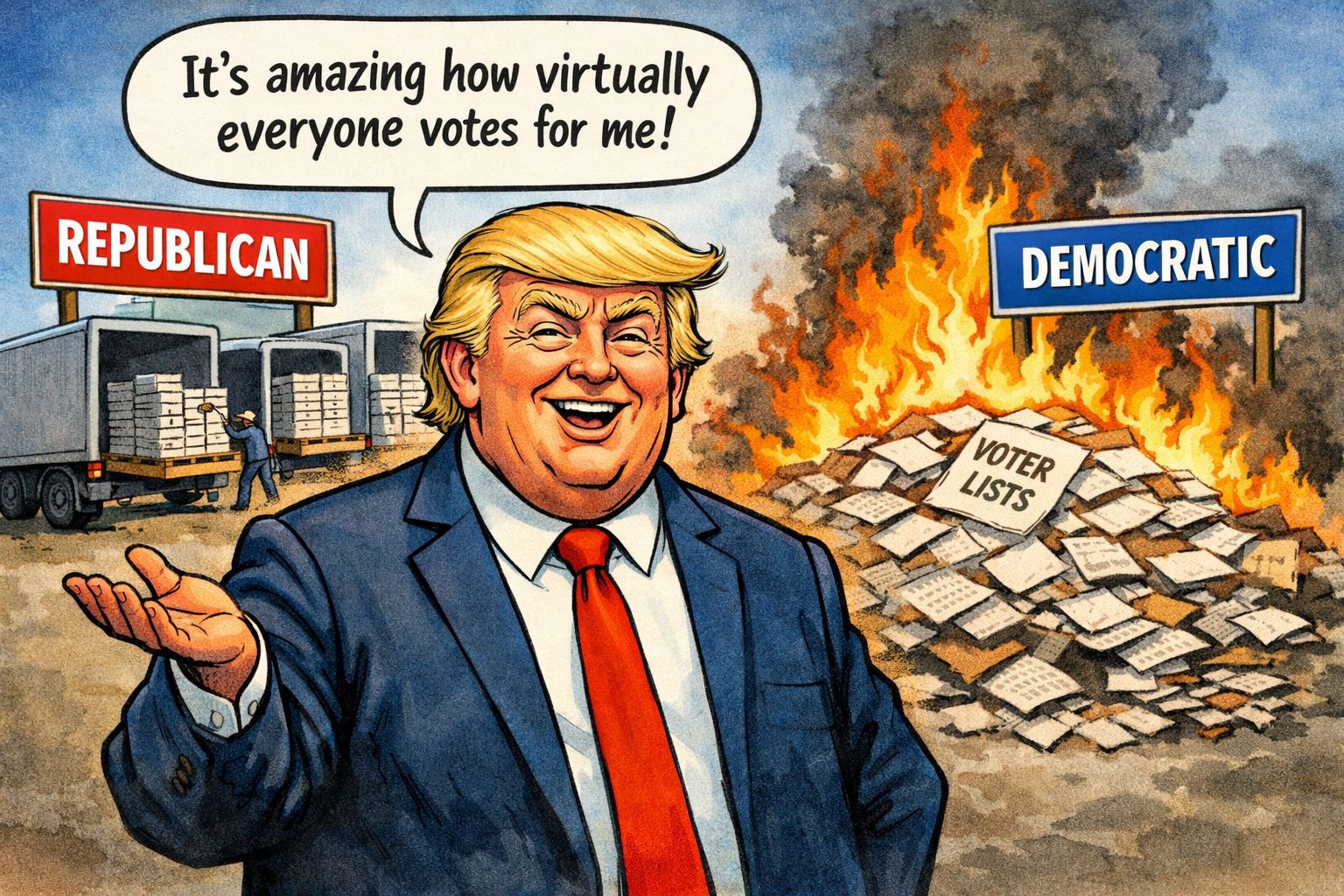
The Department of Justice (DOJ) is attempting to move election enforcement in a dangerous direction: toward striking voters from the rolls without judicial oversight. What does that mean in plain English? It means eligible voters could arrive at the polling place only to discover they’ve been removed from the voter rolls, with no way to challenge their status.
If that sounds extreme, consider the memo that the DOJ sent to multiple states. This “Memorandum of Understanding,” or MOU, not only requires states to share sensitive voter data with the DOJ but also requires states to remove voters from the rolls at the DOJ's discretion. In other words, if the Department of Justice suspects you are not a qualified voter, they can demand that your state disqualify you from voting. How does the DOJ decide if you’re a “qualified voter?” The MOU doesn’t say.
To be clear, the federal government, acting through the DOJ and subject to judicial review, does have the authority to oversee elections. This has been the case for quite some time. They ensure that federal election laws under the National Voter Registration Act (NVRA) and the Help America Vote Act (HAVA) are enforced. These laws were created to protect the right to vote and prevent states from engaging in discriminatory or arbitrary voter suppression practices. In this capacity, the DOJ helped protect our democracy.
But the language of the MOU betrays a new and disturbing direction within the Department of Justice; they are moving away from guaranteeing the right to vote to preventing it.
The relevant passage within the MOU can be seen here (emphasis mine): After analysis and assessment of your state’s VRL [Voter Registration List], the Justice Department will securely notify you or your state of any voter list maintenance issues, insufficiencies, inadequacies, deficiencies, anomalies, or concerns the Justice Department found when testing, assessing, and analyzing your state’s VRL for NVRA and HAVA compliance, i.e., that your state’s VRL only includes eligible voters. You agree therefore that within forty-five (45) days of receiving that notice from the Justice Department of any issues, insufficiencies, inadequacies, deficiencies, anomalies, or concerns, your state will clean its VRL/Data by removing ineligible voters and resubmit the updated VRL/Data to the Civil Rights Division of the Justice Department to verify proper list maintenance has occurred by your state pursuant to the NVRA and HAVA.
As you can see above, the tables are turning. The DOJ is no longer concerned with voting rights. It’s using the NVRA and HAVA as a cudgel to prevent voting rights. Further, with this MOU, the Department of Justice will bypass the court system, so its outcomes will not be challenged. The DOJ effectively becomes both prosecutor and judge, leaving ordinary citizens at its mercy.
This is not a hypothetical concern. History offers a clear warning. In the 2000 presidential election, Florida unilaterally purged thousands of voters after relying on a flawed list of alleged felons. Many eligible voters whose names were roughly similar to those of felons were wrongly removed from the voter rolls. (At the time, Florida did not allow felons and ex-felons to vote.) The U.S. Commission on Civil Rights later found that Florida’s purge list relied on inexact name matches and carried an error rate of at least 14 percent. As a result, thousands of voters never had the chance to participate in an election that was ultimately decided by a razor-thin margin. History would certainly be different without these voter roll purges.
We should be clear-eyed about the risk. An executive branch that can secretly suppress the electorate is an executive branch that can rig elections. That is not election integrity; it is election control. It allows the DOJ — and, by proxy, the president — to rig elections in their favor.
History teaches us that authoritarian regimes don’t begin with tanks in the streets. They begin by centralizing authority, weakening independent oversight, and hollowing out institutions meant to protect democracy. When enforcement replaces justice, when secrecy replaces transparency, when blind conformance replaces common sense, democracy rots from the inside.
Federal oversight of elections is necessary and has worked well in the past. Federal control exercised without judicial review is blatantly authoritarian. With this latest attempt by the Department of Justice to seize control of elections, citizens have the right—and the duty—to take action. It’s up to “We the People” to fix this mess and protect the sacred institutions that protect our freedoms.
The Briefing Leaders Rely On.

In a landscape flooded with hype and surface-level reporting, The Daily Upside delivers what business leaders actually need: clear, concise, and actionable intelligence on markets, strategy, and business innovation.
Founded by former bankers and veteran business journalists, it's built for decision-makers — not spectators. From macroeconomic shifts to sector-specific trends, The Daily Upside helps executives stay ahead of what’s shaping their industries.
That’s why over 1 million readers, including C-suite executives and senior decision-makers, start their day with it.
No noise. No jargon. Just business insight that drives results.
Reply